Why is Shein so cheap? Because someone else is paying the real price. The buy-more machine doesn't want you to see this.
Why Shein is so cheap
You've seen the prices. A dress for $8. A jacket for $14. Tops for $5 that look almost identical to something a designer charged $200 for six months ago. And something about it nags at you, even while you're adding it to the cart.
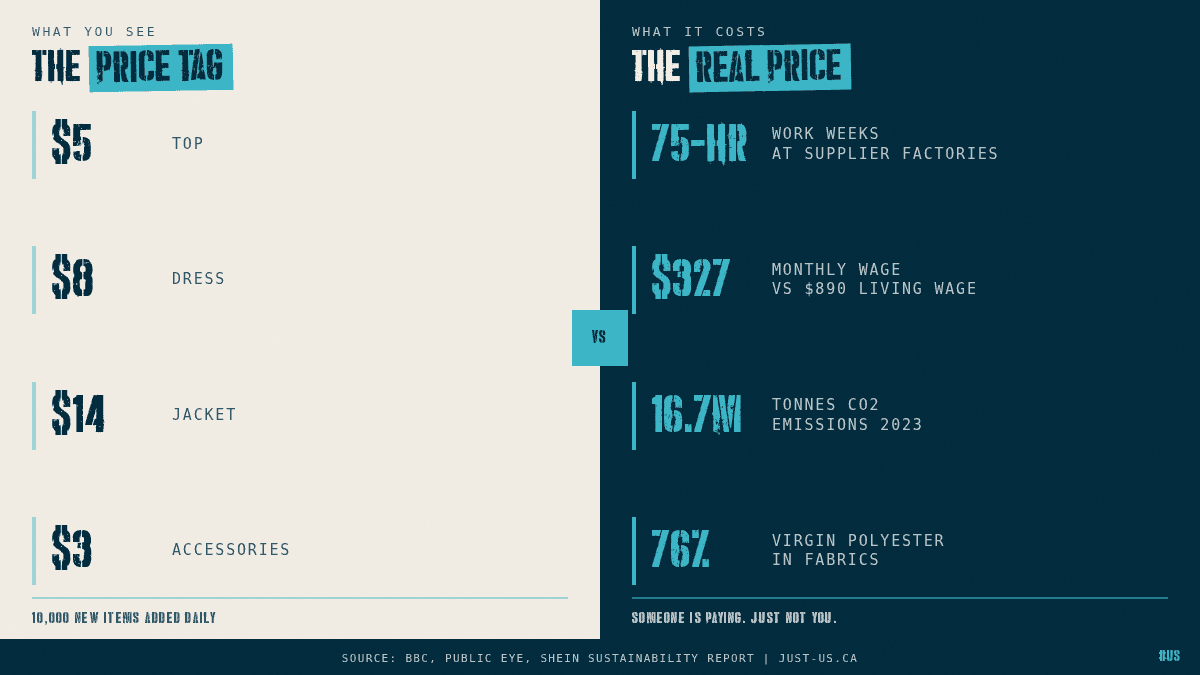
Here's the thing nobody selling you those tops wants you to think about: the price is real. Someone is paying it. Just not you.
Shein's production model runs like this. The company works with a network of nearly 7,000 clothing factories in Guangzhou alone, with close to 10,000 suppliers across Guangdong province. When a trend starts moving on TikTok, Shein's algorithms pick it up. Within three to seven days, a design is created, produced, and listed on the app. Initial runs are small — 100 to 200 pieces. If it sells, production scales. If it doesn't, it disappears.
The speed is real, and it's a competitive advantage. But speed alone doesn't explain a $5 top. What explains it is where the money doesn't go.
Shein workers: who's really paying
Let's talk about the 75-hour weeks.
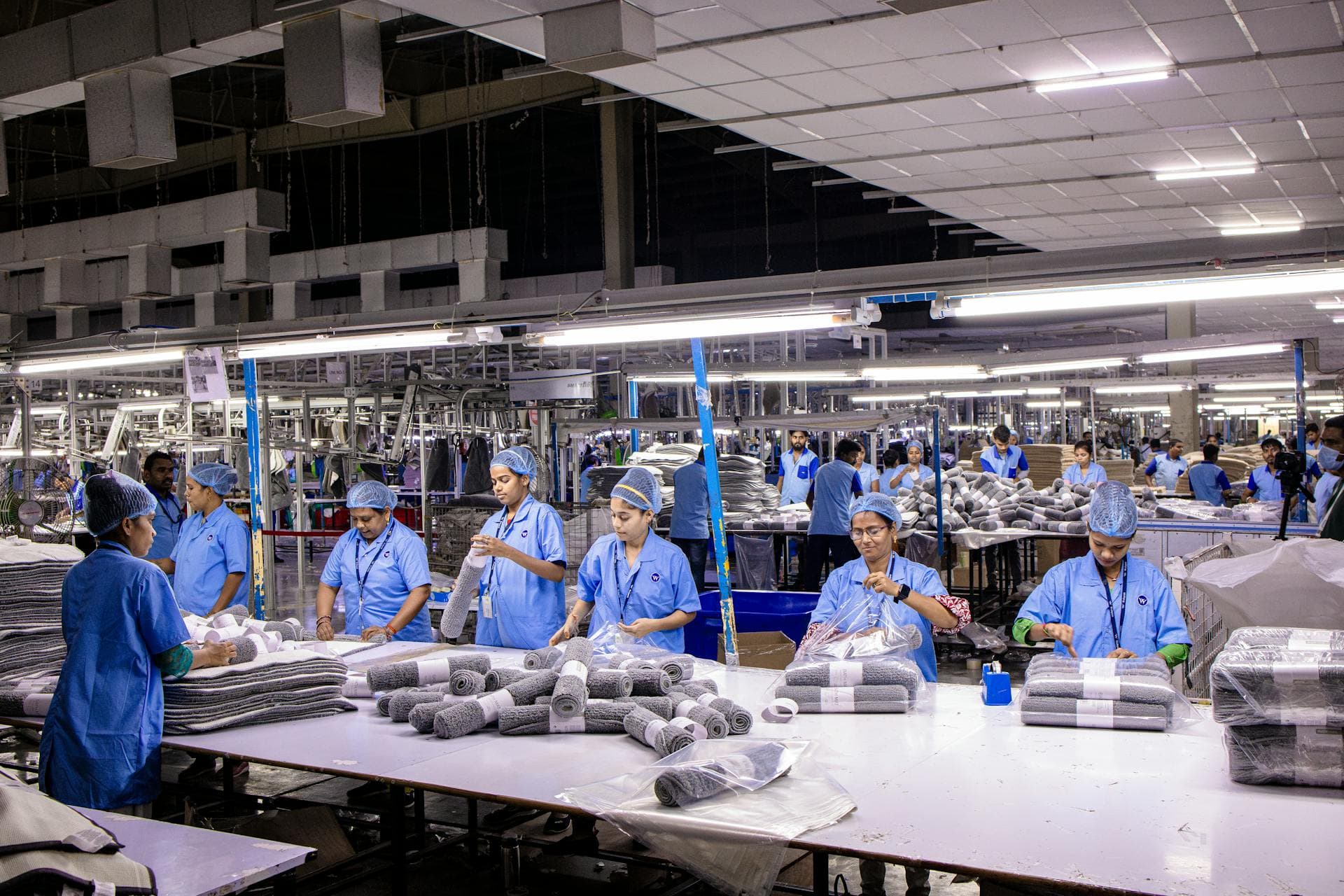
In 2023, the Swiss advocacy organization Public Eye published an investigation into Shein's supplier factories. Workers described 18-hour shifts. Wages calculated per piece, not per hour. Penalties for mistakes deducted from already thin paychecks. Shein pledged reforms. Two years later, Public Eye went back. The 75-hour weeks were still common. Wages had "hardly changed."
Chinese labor law caps a standard workweek at 44 hours, with a maximum of 36 overtime hours per month. The workers Public Eye documented were exceeding both limits routinely.
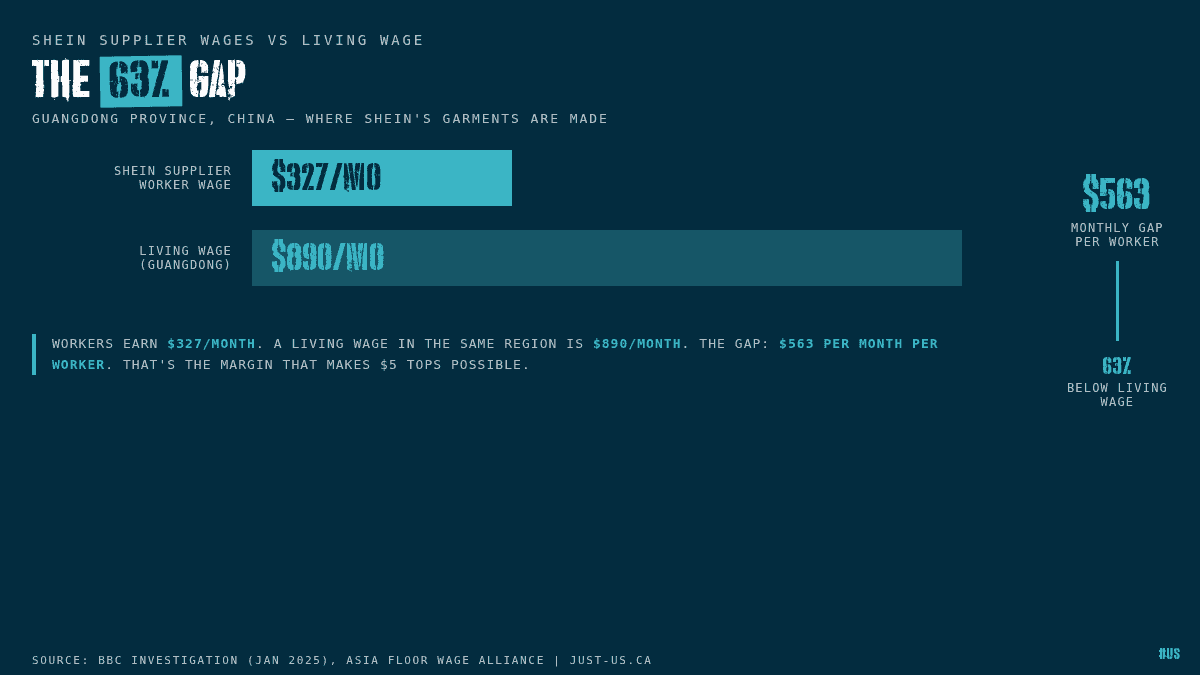
These are skilled workers. Pattern makers. Sewers. Finishers. People with years of expertise whose labor is treated as the cheapest input in the equation. The #Us movement calls this extraction, because that's what it is. Real skill, real hours, real bodies, converted into margin.
How the app keeps you scrolling
The European Commission didn't use the word "addictive" casually. Shein's app is engineered for compulsive use.
The app rewards you with points for opening it daily. For leaving reviews. For sharing products. For watching livestreams. You accumulate these points and trade them for discounts, which creates a loop: open the app, earn points, spend points, buy something, open the app again. The purchase isn't the only thing being sold. Your attention is.
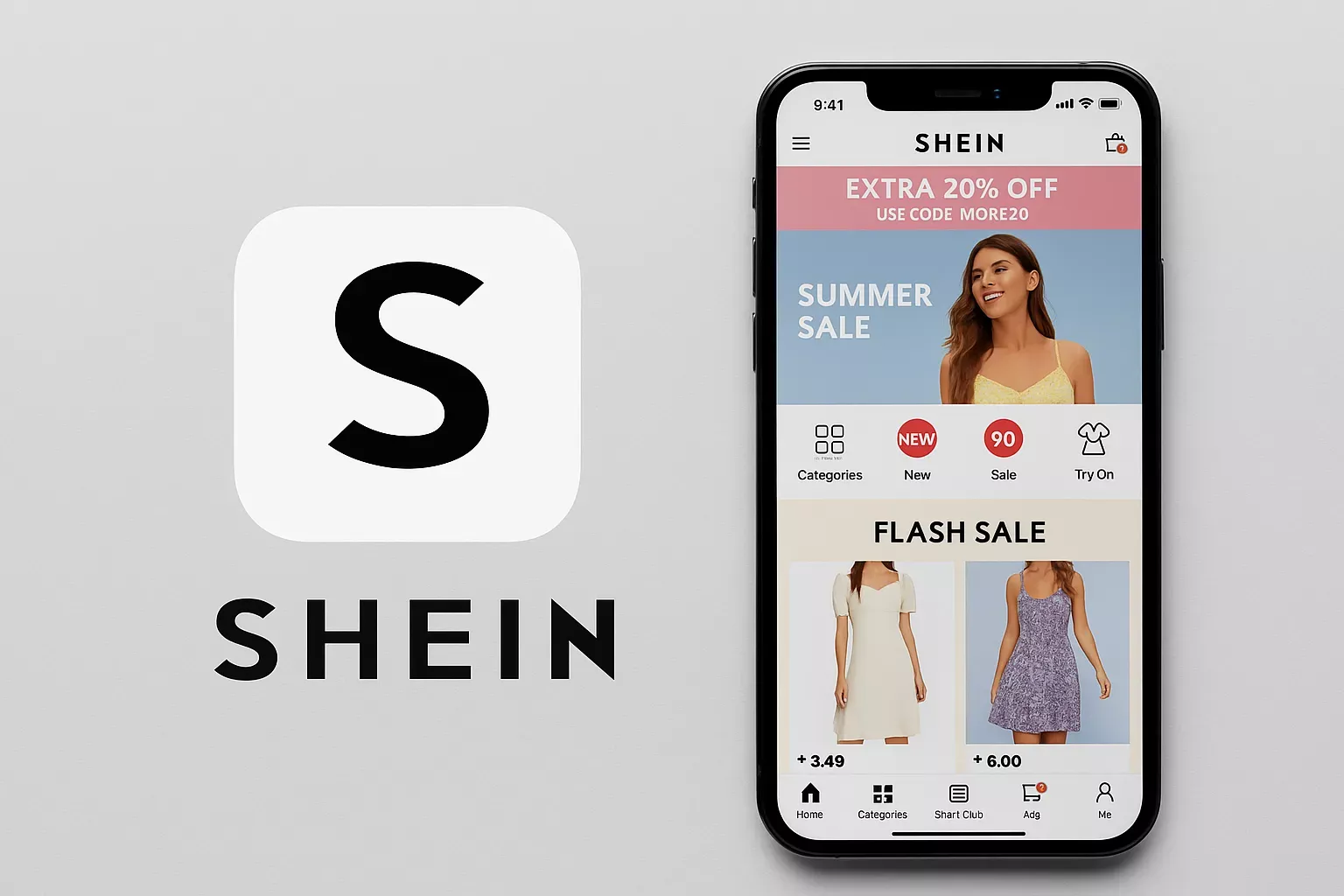
Then there's the scroll. Shein adds between 2,000 and 10,000 new items to its app every day. Traditional fast fashion retailers like H&M release about 4,500 new products per year. Shein puts up more than that in a slow afternoon. The infinite scroll works because the inventory is functionally infinite.
Shein buyers have increased their purchase frequency from 1.7 to 4.3 times per year since 2019. A 150% increase. Not because people suddenly needed more clothes. Because the app got better at making the purchase feel automatic.
The haul: overconsumption as entertainment
TikToks tagged #sheinhaul have 2.6 billion views. That's not organic enthusiasm. It's a marketing strategy.
Shein gifts massive product hauls to creators. The creator unboxes 20, 30, sometimes 50 items on camera. The audience watches someone else experience the dopamine of opening new things. Comments fill with "link?" and "I need this." The video becomes a shopping list. The creator gets engagement. Shein gets sales. The viewer gets a manufactured feeling of scarcity: everyone has this thing except me.
The average fast fashion purchase lasts fewer than ten wears before it's discarded. Roughly 25–30% of Shein purchases are returned or thrown away after one to three wears. At Shein's production scale, that's hundreds of millions of garments cycling through closets and into landfills every year.
The haul isn't content. It's the business model's delivery mechanism.
What to do instead
You're not broken for shopping at Shein. The app is literally designed to be addictive. The prices are designed to make saying no feel irrational. The whole system is built so that buying feels like the obvious, easy, maybe even smart thing to do.
But you have options that don't feed the machine.
Love the aesthetic? Look secondhand first. Depop, Poshmark, ThredUp, and local thrift stores carry enormous amounts of trend-driven clothing that's already been produced. Same look. No new production. No new extraction.
Want to buy less but better? The math actually works in your favour. Three pieces that last two years cost less over time than twenty pieces that last two months.
Want to do something about it? Talk about it. Not to shame anyone who shops at Shein — most of us have. But to make the system visible. The invisibility is the power. Once you see how the $5 top is made, you can't unsee it. And once enough people see it, the math changes.
“A $5 top with a 600% markup. The margin isn't in the fabric. It's in the volume.”